
Deconstructing the Mafia Myth
The Cosa Nostra in popular culture

The Mafia is not an actual organisation itself. There is no head of the Mafia. Instead, the word Mafia is an umbrella term that refers to any several groups of gangsters who can trace their roots to Italy or Sicily
Quote: Marta Zapala-kraj, ‘Mafia – the History with Mario Puzo’s Godfather in Background,’ (PhD diss., GRIN Verlag, 2010) 16
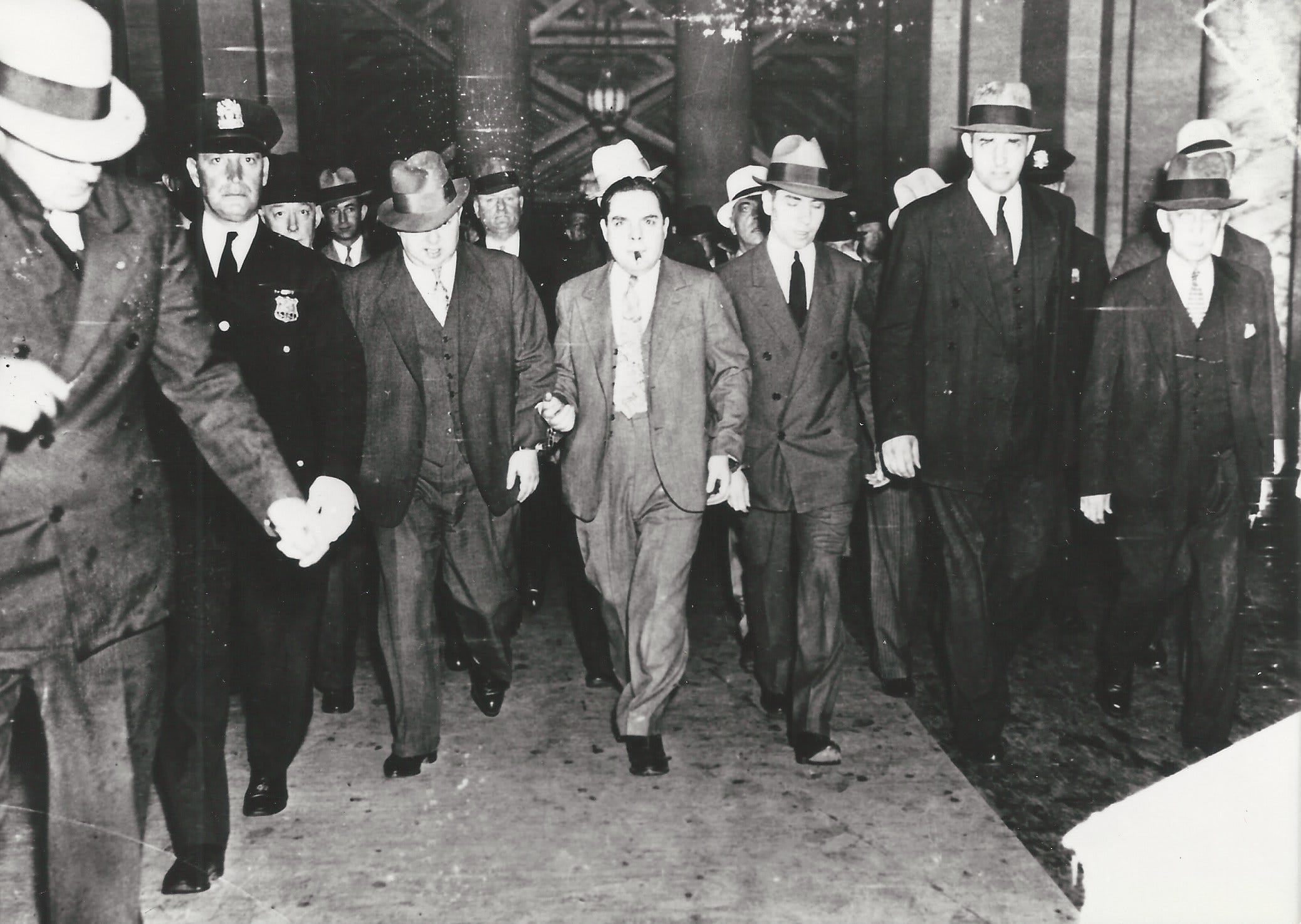
For over half a century, the global understanding of organized crime has been filtered through the sepia-toned lens of Francis Ford Coppola’s film adaptation of Mario Puzo’s writing. Yet, in dismantling the romanticism of this fiction, we uncover historical and social complexities in the make up of organised crime in the United States. By deconstructing the Godfather narrative, we uncover a story of exploitation, state-like governance, and the persistence of a fictionalised narrative which has obscured a reality that is at times pitiless and mired in self-parody, and at others bureaucratic and banal.
From around the 1960s, the U.S. government was finally beginning to get a grip of the secretive organisation that was the Cosa Nostra. Just as the reality of organised crime was coming to light, a fictional narrative had emerged that would blur the line between the history of organised crime under the Mafia, and how it was presented in popular culture. In this article, we unearth how a literary phenomenon transformed a criminal structure into an American epic, and what that meant for the realities of organised crime in twentieth century America.
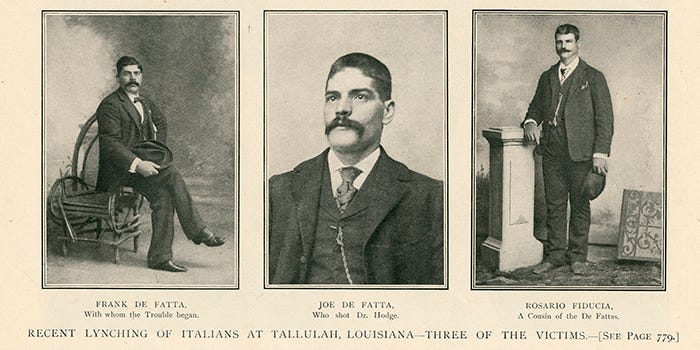
The Italian-American Mafia did not emerge in a vacuum. It was the byproduct of a seismic shift in American demography. Between 1890 and 1910, Italian immigration to New York surged from roughly 74,000 to over 2.1 million. The diaspora carried with them the scars of centuries of European feudalism, the social hierarchy that accompanied such a long history to a nation that was still forging its own. They had also adopted a deep-seated suspicion of the state: and a cultural trait known as omertà. In these early years, the “Mafia” was less an organisation and more a survival mechanism. However, to the American establishment, it was alien, and, rich pickings for fantasists and propogaters of anti-immigrant sentiment. Dwight C. Smith, Jr., writing in Italian Americana, notes that the American public’s first major encounter with the term was sparked by a specific moment of urban crisis: “American examples first circulated at the end of the nineteenth century, after the 1890 murder, alleged to be the work of the New Orleans Mafia, of David Hennessey. Publicity concerning an American Mafia was sporadic during the next sixty years, and fiction examples followed suit.”
The Hennessey murder served as a catalyst for a narrative that would persist for a century This period was defined by La Mano Nera (The Black Hand), which many historians now argue was not a single organisation but a method of extortion used by disparate groups and even lone individuals. Yet, the media of the time needed some unifying moniker to embody this perceived organised criminal underworld; and thus the ‘Mafia’ label was cemented in the American lexicon as a shorthand. For over a century, scholars and law enforcement have fought over the “true” shape of the Mafia. As has been regularly explored here at Consequences: History, how we define a group dictates how we treat them. Maurizio Catino, writing in the European Journal of Sociology, identifies two “reductive and inadequate” schools of thought that dominated the debate until the 1980s:
The first approach argues that the mafia is not an organization, nor a cohesive unit or a corporate group: rather, it is a cultural phenomenon... or a collective attitude... The second approach conceives of the mafia as a hyper-centralized organization, pyramidal and top-down, similar to a multinational firm, like an octopus with a head and a host of tentacles. There is a top level which makes all the decisions and a base that faithfully carries these decisions out. Both approaches have their limits: the cultural view underestimates organizational aspects, while the hyper-centralized idea overvalues them.
The “cultural view” allowed society to blame the immigrant community as a whole, while the “hyper-centralized” view - popularised by Federal Narcotics Bureau agents in the 1950s - created a convenient, corporate-style enemy that justified massive increases in law enforcement funding. It was into this tension, between a vague “mafioso spirit” and a rigid “Commission”, that Mario Puzo’s The Godfather came to the cultural foreground.
An ignorance of mafia activities and structures, compounded by notions of Omertà (the Sicilian code of silence) has meant law enforcement and scholars alike lack detailed sources to fully grasp the nature of this form of organised crime. In its absence, conjecture and rumour abound. For instance, a cornerstone of the mafia’s criminal enterprises was their infiltration of the American Labour movement. It is interesting to note that little academic work has been produced concerning the extensive corruption of the American Labour Movement by the Mafia. James B. Jacobs notes that:
While there has been much academic writing about the decline of the American Labour Movement since approximately 1960…I don’t know of any scholarly article or book that even suggests that the corrosive impact of labour racketeers on union organising and administration might have undermined the labour movement’s activeness and strength.
Not until 1963 was there any tangible notion of a hierarchical structure to mafia enterprises, as David Critchley explores in ‘The Origin of Organised Crime in America’ (2009). Similar systems of criminal activity have existed since the later period of the nineteenth century and yet it took until 1963 for the US government to begin investigations into these organisations. Simply, the fact that little is known about the Mafia leaves a huge void that has been filled by rumour that circulates the nation’s populace and is encouraged by misinformed government authorities as well as aspects of popular culture such as ‘the Godfather’ and other fictional gangster films
Puzo and the humanisation of organised crime
In 1969, Mario Puzo provided a narrative around the Mafia that looked past the rather disembodied interpretations made by US media and law enforcement until that time. By framing the Corleone family through the lens of tragic heroism, Puzo created a romanticised reality. Commenting on the broader literary milieu around this subject, Letizia Paoli observes, that these works were so successful that they “profoundly shaped a general understanding of the mafia... for many people the Italian American Mafia is and behaves as it is recounted in these romanticising novels and films.” The genius of Puzo’s legacy was the injection of human emotion into a criminal framework. Dwight C. Smith, Jr. notes:
Puzo’s legacy to this body of fiction was his plot and a name, mafia. They were largely a reflection of Joseph Valachi’s 1963 testimony concerning kinship-based criminal groups... His central characters, the Corleones, were portrayed as fallible persons, guided by normal human emotions (albeit through a particular view of the world), not as evil-minded criminals.
By making Vito Corleone a man of honor who only turns to crime because the American Dream failed him, Puzo created a narrative of protective crime. This is the great falsehood perpetuated around this form of organised crime: that the Mafia exists to protect the community from a corrupt state. However, Filippo Sabetti argues that this fictional paradigm has led us to misunderstand the actual power structures at play. He warns that our obsession with the cinematic Don blinds us to the fragmented and deeply political nature of these groups: “The vision [of a single hierarchy], while satisfying for cinema, ignores the reality of a world made up of fluid, often competing groups whose power was derived more from local social networks than from a centralized ‘commission.’ By focusing on the myth of the ‘Don,’ we lose sight of the fragmented and deeply political nature of these organizations.”
To deconstruct the myth, we must look at the actual organisational orders: Vertical and Horizontal. Maurizio Catino’s research provides the structural counterpoint to Hollywood’s “Capo di tutti capi.” In the fictional world, the Boss of Bosses is a stable position of absolute power. In history, the picture is much more blurred. Catino highlights the Castellammarese War of the 1930s as a prime example of the failure of extreme verticality: “Historically, the experience of extreme hierarchical centralization seems destined to fail... Two bosses, Salvatore Maranzano and Giuseppe ‘Joe the Boss’ Masseria, tried to become the boss of the bosses in New York City in the 1920s... Maranzano won the war and tried to exercise hegemony over other mafia groups, arousing strong opposition from them. The role of ‘boss of bosses’ did not last long and Maranzano was quickly eliminated by other families.”
Real Mafia power is not held by a single figurehead; it is a “monopolistic control of every relevant economic activity” achieved through a variety of “market governance” activities. Catino identifies a paradox in how these structures use violence:
The presence of higher levels of coordination allows mafia organizations to better control conflict and reduce the number of ‘ordinary’ murders committed. At the same time, mafias with vertical organizational orders are in a better position to fight state repression, thus carrying out a greater number of ‘high-profile’ killings (e.g. politicians, magistrates, and other institutional members). However, vertical orders are more visible and therefore more vulnerable to the repressive action of law enforcement Agencies.
This suggests that the peaceful reign of a cinematic Don is actually the sign of a highly coordinated vertical order that has successfully suppressed internal dissent while increasing its capacity to strike at the state. Rather than peace, it is total control, and totally unrealistic.
The success of Puzo’s work spawned an entire genre that Dwight C. Smith, Jr. calls the “Sons of the Godfather.” This literary explosion, comprising hundreds of novels, solidified the “Mafioso” as an American superhero. Smith identifies several damaging tropes in this genre, most notably the Superhero Archetype, where central figures are invariably accurate shots and demonstrate an uncanny grasp of tactics, and the Morality of Vendetta, where “good guys” behave as if they are obedient to principles beyond the law. This genre reinforces the idea that “big-league crime is Italian,” creating a cultural archetype that shadows the millions of Italian-Americans who have nothing to do with organised crime. Smith concludes with a sobering reflection on how Puzo’s talent, while immense, created a legacy that hinders our search for justice: “The result is a legacy of public attitudes toward crime, Italians, and the law that will do little to advance the search for equity and justice that a democratic society must undertake.”
These tropes were only enhanced by efforts from the government to crack down on organised crime. As Sabetti explains: “The [government] commission also heightened expectations about its work that could not be realistically met, thereby fuelling the imagination of many writers eager to use the mafia as a highly politicised explanatory deus ex machina for institutionalised corruption.” It was not until the Mafia Commission Trial of the mid 1980s when the mafia (as it was publicly understood) was finally brought down. Previous investigations in the 60s and 70s had merely popularised, if not mythologised the criminal activity of these groups. In this manner legal recourse converged with the subculture of mafia fiction to cement the distorted view of the mafia many still hold today.
The female voice of the Mafia
The Godfather narrative is famously masculine. Women are either the protected domestic anchors (Mama Corleone, Kay Adams) or the grieving victims (Apollonia). This erasure of female agency is one of the most significant consequences of the mafia myth. Felia Allum’s research into the Neapolitan Camorra unpacks this domestic trope. She reveals that women are not merely passive bystanders but a reserve army of strategic leaders. Crucially, she argues that their rise is not a sign of emancipation but of “functional exploitation”:
… despite women’s high-ranking positions within mafia clans, their professional development is best explained not as a sign of ‘female emancipation’... but rather as functional exploitation by the clan when resources are limited in times of crisis. Thus, conceptualizing Camorra women as a ‘reserve army’ can be a more useful analytical framework to explain the leadership positions of the women who come to occupy relevant positions in the traditionally men-dominated Camorra clans.
These women managed finances, relayed orders from imprisoned husbands, and coordinated hits. By viewing them through the lens of a “reserve army,” we see the Mafia for what it truly is: a predatory machine that adapts its gender roles only to ensure the survival of the enterprise. The romanticised protection of the family is, in reality, the mobilisation of every family member to protect the profit margin. This strategic utility of women is a far cry from the submissive figures of the Corleone family. It reflects a reality where the family is less a model of traditional values, and more a human resource pool for a criminal firm.
Beyond the myth: how the Mafia was structured
To understand the reality of the Mafia, we must move past the idea of criminal activity being the sole determinant factor and toward the idea of governance as a defining feature. Maurizio Catino and Diego Gambetta argue that the Mafia is essentially an industry that sells private protection. They provide protection against extortion (which they often create), theft, and police harassment. They settle disputes and intimidate trade unionists. As Catino notes, the “core business of mafia organizations is ‘market governance’, the monopolistic control of every relevant economic activity.” This is the reality that the Godfather myth obscures. The Corleones are not protectors of the neighborhood; they are monopolists who charge a protection tax on the neighborhood’s very existence. They are a parallel state that thrives where the actual state is weak or corrupt.
Catino points to Thomas Schelling’s crucial distinction in expanding on this point of governance:
Schelling points out that organized crime is substantially different from crime that is organized (1971: 72). Both operate in the world of illegal markets, but the former includes crime that involves functional role division, planning, and cooperation. The latter attempts to actually govern them, by seeking to achieve a monopolistic control on illegal economic activity. Paradoxically, the monopolistic tendency of organized crime may bring about positive externalities compared to disorganized crime, because the monopoly over criminality guarantees greater control over violence (Buchanan 1980). Paraphrasing Adam Smith, ‘it is not from the public-spiritedness of the leader of the Cosa Nostra that we should expect to get a reduction in the crime rate, but from their regard for their own self-interest’.
This is a vital point for the historian. If we view the Mafia merely as a collection of criminals, we miss their primary function: governance. That said we must consider Catino’s earlier argument about the risks of considering the mafia in hyper-centralised terms.
The reality is that the Mafia operated in between a cultural dynamic and a hierarchical structure - it was fundamentally a rules-based system; even if the rules were vague, inconsistently enforced, or broadly misinterpreted by external parties. Catino explains:
Rules exist both within a family, and between families: a system of formal regulations, sometimes in written form, of formal criminal constitutions. These rules discipline organizational life, from the recruiting phase on. Initiation rites too are strictly regulated... The oath taken to be a member of the organization, as a man of honor, is binding for life, and it requires a subordination of all allegiances to mafia membership.
Even today, a comprehensive understanding of the structural nature of the mafia remains elusive. Interpretations remain numerous and varied. The closest it came to a recognisable and coherent system of organised crime - well regulated, with a semblance of ordered operations with little inter-family conflict - was at the end of its life: in the 1980s as the FBI finally closed in to take down the Commission.
In the end, it is easy enough to understand the attachment to a romanticised version of the mafia as portrayed in The Godfather when one considers the cultural context of the day. For a 1970s audience reeling from the Vietnam War and Watergate, the Corleones offered a vision of a world where “family” and “honor” still meant something, even if that world was built on brutal violence and oppressive criminal activity. New York of the 1970s was one characterised by corruption and a distinct lack of public safety. One need only be reminded of the founding of the Guardian Angels in 1979 and films like The Warriors (also 1979) as responses to the social context at the time. nevertheless, one thing is for certain - the history of the mafia is not a tragic story of loyalty and community to be romanticised. Rather, it is a history of functional exploitation, tactical violence, and the systematic distortion of immigrant life. It is a history of vertical and horizontal orders fighting for the right to govern the illegal market.
By looking past the myth of the Don, we can begin to see the true consequences of this legacy: a misunderstood community, a distorted legal system, and a cultural archetype that has silenced the female voices of the “reserve army” and the victims of “market governance.” Are we capable of seeing the history of American crime without the filter of Hollywood? Can we appreciate the artistry of Coppola while acknowledging the damage of the “Godfather effect”? Let us know what you think in the comments.
Sources:
Allum, Felia & Marchi, Irene. “Analyzing the Role of Women in Italian Mafias: the Case of the Neapolitan Camorra.” Qualitative Sociology, 41 (2018): 339–358.
Catino, Maurizio. “How Do Mafias Organize? Conflict and Violence in Three Mafia Organizations.” European Journal of Sociology, 55, no. 2 (2014): 177–220.
Paoli, Letizia. Mafia Brotherhoods: Organized Crime, Italian Style. Oxford University Press, 2003.
Sabetti, Filippo. “The Mafia Misunderstood – Again.” Journal of Modern Italian Studies, 11, no. 2 (2006): 232–239.
Smith, Dwight C. “Sons of the Godfather: ‘Mafia’ in Contemporary Fiction.” Italian Americana, 2, no. 2 (1976): 190–207.
Critchley, David, ‘The Origins of Organised Crime in America: The New York Mafia 1891-1931’, (Taylor & Francis US, 2009)
Dash, Mike, ‘The First Family: Terror, Extortion, Revenge, Murder, and the Birth of the American Mafia’, (Doubleday Canada, 2009)
Jacobs, James B., ‘Mobsters, Unions and Feds: the Mafia and the American Labour Movement’, (NYU Press, 2006)
Mallory, Stephen L., ‘Understanding Organised Crime’, (Jones & Bartlett Learning, 2007)
Paoli, Letizia, ‘Mafia Brotherhoods: Organised Crime, Italian Style’, (Oxford University Press, 2003)
Zapala-Kraj, Marta, ‘Mafia- The History with Mario Puzo’s Godfather in Background: The Development of Italian Mafia in America in context of both literature and movie’, (PhD diss., GRIN Verlag, 2010)
Dickie, J., ‘The Mafia Misunderstood – again. A Reply’, Journal of Modern Italian Studies, 11. 4 (2006): 581-583
Coppola, Francis Ford, ‘‘the Godfather’ by Mario Puzo’, (1972)
Puzo, Mario and Francis Ford Coppola, ‘the Godfather’, (1972)
Propaganda Due Italian Masonic Lodge was the real mob